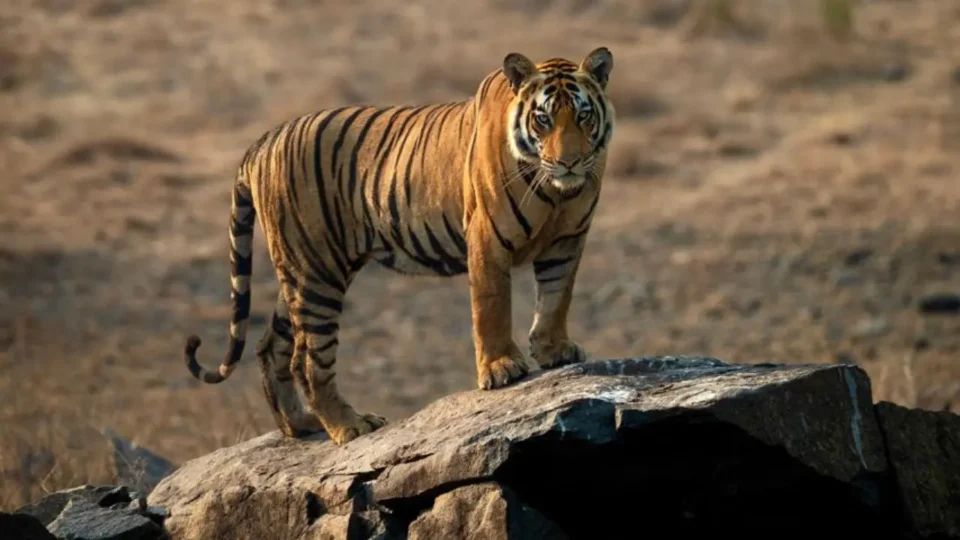
As many as 5,765 wildlife sightings, including 42 tigers, were recorded during the annual `Machan Census on Waterholes` at Tadoba-Andhari Tiger Reserve (TATR) in Maharashtra`s Chandrapur district on Buddha Purnima, an official has said.
The data reflected a healthy and thriving ecosystem, with a robust prey-predator balance across both core and buffer zones, TATR Field Director Prabhu Nath Shukla said on Saturday.
The exercise, conducted on Friday, aimed to assess wildlife presence during peak summer when animals gather around water sources, he said.
Every year, this census is carried out on Buddha Purnima as the full moon offers better visibility. It also sees extensive participation from volunteer wildlife lovers. A total of 210 participants contributed to the exercise in the buffer zone this time.
Herbivores (ungulates) dominated the sightings with 3,089 observations (53.6 per cent), indicating a strong prey base, Shukla said.
Omnivores (monkeys and wild boar) accounted for 1,500 sightings (26 per cent). Birds contributed 573 sightings (9.9 per cent).
The participants observed 209 `mega carnivores`, including tigers, leopards and others, and 212 small carnivores. In all, 42 tigers and 13 leopards were spotted.
They also observed 1,700 spotted deer, more than 600 sambar deer, over 500 Indian gaur, as well as nilgai (blue bull), barking deer, wild boars, and crocodiles, as per the official.
This story has been sourced from a third party syndicated feed, agencies. Mid-day accepts no responsibility or liability for its dependability, trustworthiness, reliability and data of the text. Mid-day management/mid-day.com reserves the sole right to alter, delete or remove (without notice) the content in its absolute discretion for any reason whatsoever.
Why `Machan Census` at Tadoba reserve is conducted on Buddha Purnima