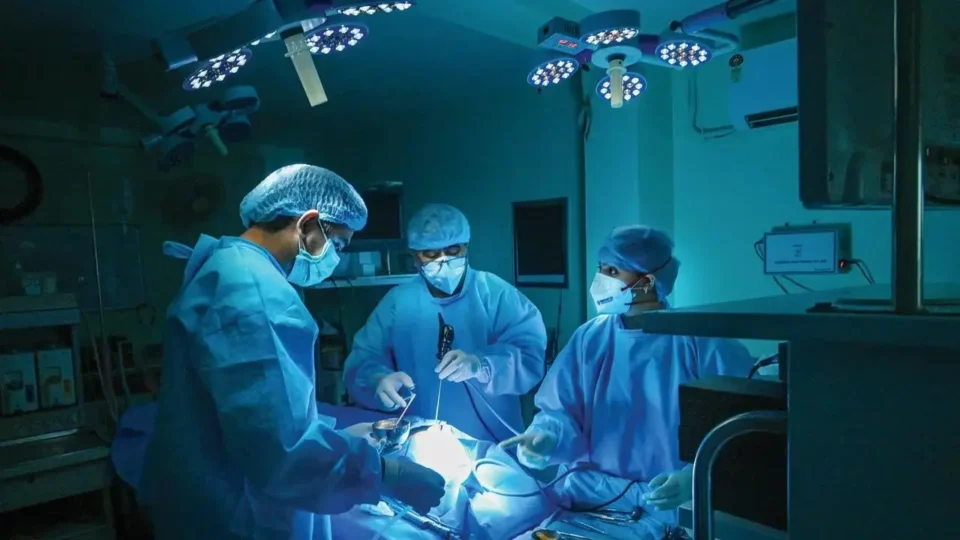
A 27-year-old woman, Shahad Siraini from Oman, whose health rapidly deteriorated due to a rare hormonal disorder, found a new lease on life after Mumbai doctors came to her rescue to conduct an advanced minimally invasive surgery.
It also started when unexplained weight gain initially soon escalated into a complex medical condition. Within three months, she gained nearly 16 kilograms and developed diabetes, hypertension, swelling across her body, purple stretch marks, acne, hair loss, excessive facial hair growth, irregular menstrual cycles, persistent fatigue, and muscle weakness.
The turning point came when she suffered severe back pain, with investigations revealing a D12 vertebral compression fracture – an unusual finding in an otherwise healthy young adult. Although each condition was treated separately, the underlying cause remained unidentified until a comprehensive endocrine evaluation diagnosed Cushing’s disease, a rare disorder caused by an Adrenocorticotropic hormone (ACTH) secreting pituitary tumour leading to excessive cortisol production. Recognising the complexity of her condition, the patient travelled to Jaslok Hospital & Research Centre, where a multidisciplinary pituitary team successfully managed her case.
On July 1 this year, she underwent a minimally invasive endoscopic endonasal pituitary surgery, a specialised procedure performed entirely through the nasal passage without any external incision.
The surgery was led by Dr Raghvendra Ramdasi, consultant – Skull Base Neurosurgeon along with Dr. Rakesh Katna, consultant – ENT Skull Base Surgery. Anaesthetic care was provided by Dr Saavi Kapila, neuroanesthesiologist, while endocrine management was overseen by Dr Shaival Chandalia, consultant – Endocrinology. Her spinal fracture was evaluated by Dr Manish Kothari, consultant – Spine Surgery, and her diabetes, hypertension, and other systemic complications were managed by Dr Indraneel Raut, additional director – Critical Care Medicine.
The surgery yielded encouraging early results. Her serum cortisol levels reduced dramatically from 1432 µg/dL (11 June 2026) to 0.752 µg/dL (7 July 2026), and she had her menstrual cycle after four months, indicating successful biochemical remission following removal of the tumour. Doctors expect her diabetes, blood pressure, bone health, hormonal balance, and overall quality of life to improve progressively as cortisol levels normalise.
Dr Ramdasi said, “By the time patients with Cushing’s disease reach a neurosurgeon, they often already carry several complications from prolonged exposure to excess cortisol. On the scan, the tumour looked small, but at surgery it was almost double that size. With these functional, hormone-producing tumours, removing part of it is not enough — the entire tumour has to come out, while preserving the healthy gland around it. Working through the nose with an endoscope, with no external incision, we were able to remove it in full, giving the patient the best chance of hormonal recovery and lasting remission.”
Dr Chandalia, added, “Cushing’s disease is often called a ‘great imitator’ because its symptoms mimic several common conditions such as obesity, diabetes, hypertension and menstrual irregularities. The key lies in recognising the pattern rather than treating each problem in isolation. Timely hormonal evaluation, accurate diagnosis and close collaboration between endocrinology and neurosurgery are critical to achieving cure, preventing irreversible complications and restoring a patient’s quality of life.”
On her recovery, Shahad cheerfully commented, “For months, I struggled with unexplained weight gain, weakness and several health problems without knowing the real cause. Coming to Jaslok Hospital gave me answers and hope. The doctors treated me with exceptional care and compassion, and today I feel like I’ve been given a second chance at life. I look forward to returning home healthier and stronger.”
Although Cushing’s disease is uncommon and only a limited number of cases have been reported in Oman, this successful treatment highlights the importance of recognising the condition early and the value of specialised multidisciplinary care. As the young woman returns home to continue her recovery, her journey stands as a reminder that seemingly unrelated symptoms can often point to a single underlying disorder—and that timely diagnosis can be life-changing.
Oman woman gets new lease of life after Mumbai docs treat rare hormonal disorder