Long before representation became a talking point, queer kids were doing what they had always done: reading between the lines. Finding themselves in the margins of stories that were never written for them. A villain who refused to be diminished, a sitcom character who didn’t care about fitting in, and a teenage girl with a secret so big it bent her whole life out of shape, none of these characters were queer. But the kids watching them were paying a different kind of attention — the kind that is less about what’s on screen and more about what it unlocks inside you.
There’s a particular kind of queer childhood literacy that develops in the absence of direct representation: an ability to locate yourself in subtext, in metaphor, in the negative space of a story. You learn to find the feeling even when the story doesn’t name it. A secret that changes everything, and a person who exists just outside the edges of what’s considered normal and survives there anyway.
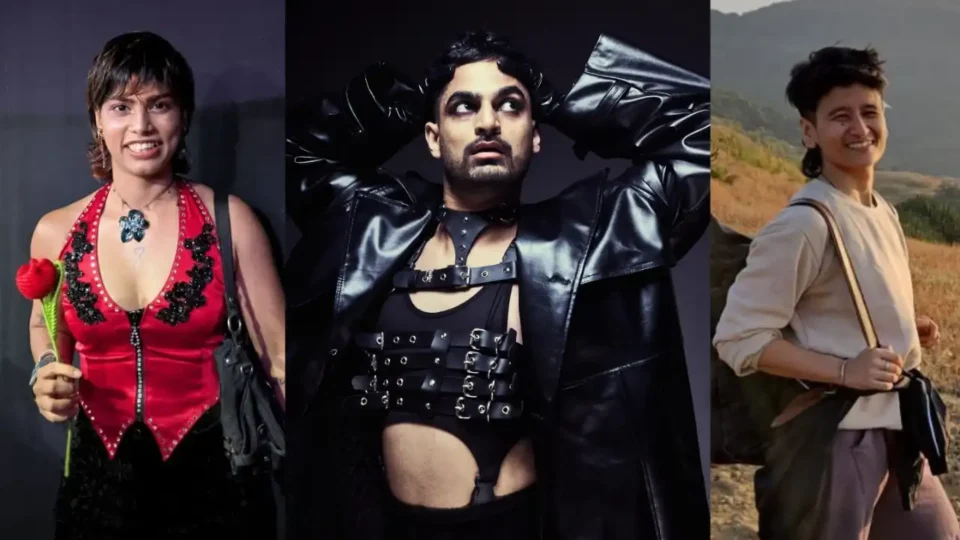
This Pride Month, we asked four people to name the character who held something true about their experience before they had the words for it themselves.
‘She didn’t fear anything, and I feel I’m strongly inclined towards her’
Reena Barretto is a 31-year-old Mumbai-based marketer, stylist, and bisexual woman. Having played video games since childhood, she finished the first part of The Last of Us on PS3 when she was in 11th grade. Long before mainstream television caught up, gaming narratives were providing complex, fierce spaces where young queer folks could anchor their developing sense of self.
The second came out in 2020. She finished that too. What kept drawing her back was Ellie herself. “She is a very fierce character, very strong and confident. She didn’t fear anything, and I feel I’m strongly inclined towards her because all that I am now is the resilience and strength to face anything that life throws at me. I know I’ll manage and thrive over and over and over again,” she reveals.
The queer connection clicked in over time. In the first game, Ellie is attracted to her best friend. By the second, her story with a woman is central. For Reena, the recognition was layered — the strength first, then the love story. Reena calls Ellie her first, and tells us about her second, “Vi from Arcane which just released a few years back on Netflix. Another fierce woman, and another screen I couldn’t look away from.”
‘I admired their confidence, individuality, and unapologetic self-expression’
Saurav Singh is a 26-year-old gay performer, choreographer, and dance educator based in Gurgaon. Before finding the vocabulary for his identity, Saurav found a sanctuary in the fierce self-expression of 2000s and 2010s pop royalty, learning how to take up space in a world trying to shrink him.
Saurav’s answer doesn’t name a single fictional character. It names a feeling — the feeling of watching women who absolutely refused to apologise for themselves. Growing up, before he had language for his own identity, he found himself magnetised to pop stars: Miley Cyrus, Nicki Minaj, Ariana Grande. “I admired their confidence, individuality, and unapologetic self-expression. I would watch their music videos, performances, interviews, and try to recreate their energy. It wasn’t just about the music, I was obsessed with the attitude, the glamour, the confidence, the freedom they represented,” he recalls.
One moment stands out. Watching Miley Cyrus face the relentless criticism of her Bangerz era and keep going anyway. “Everyone had an opinion about her and was constantly judging her choices, but she continued to show up unapologetically as herself. Looking back, that was incredibly empowering for me,” he shares.
Saurav is someone who teaches people to move, to take up space with their bodies. There’s a direct line between those childhood music video sessions and what he does for a living: practising someone else’s confidence until it became his own. “No one can truly harm you unless you hand them that power. Watching these artists own their stories gave me permission to own mine,” he concludes.
‘Her entire existence was structured as a profound metaphor for the queer experience’
Maya (name changed on request), is a freelancer, working remotely from Pondicherry. The 34-year-old cis-queer woman had no framework for her identity when she first started watching Buffy the Vampire Slayer. She wasn’t looking for a mirror. She found one anyway — in a teenage vampire slayer. “There was nothing explicitly queer about the titular character Buffy Summers but her entire existence was structured as a profound metaphor for the queer experience,” she muses.
What struck Maya wasn’t the monster-fighting. It was the architecture of Buffy’s life — the constant, exhausting management of a secret too large to carry alone. Buffy was chosen, marked, different in a way she hadn’t asked for and couldn’t undo. “She was forced to lead a double life, constantly hiding her true identity from her mother, her school, and society. The anxiety of being exposed, the pressure to conform to a normal high school experience, and the exhaustion of maintaining a facade are instantly recognisable to anyone who has spent time in the closet,” she admits.
The show also gave Maya something she hadn’t seen before: a community built entirely around a shared secret. “Buffy’s inner circle knew what she was and loved her anyway. They gathered in a school library, spoke in coded language, and found in each other a chosen family that the rest of the world couldn’t quite see. For a teenager in small-town India with no visible queer community around her, the image of people finding each other and building something warm and loyal in that space meant more than any explicit storyline could have,” she explains.
The show, she notes, also let Buffy be messy, overwhelmed, occasionally wrong. She saved the world and still couldn’t hold her life together. Being different wasn’t noble or clean, it was just relentless. “That imperfection mattered as much as the metaphor,” Maya says. Buffy knew that particular exhaustion. So did she.
‘I even loved the fact that everyone called them Bhai’
Krit, 32, trans-masculine nonbinary, is a consultant based in Noida. Their number one pick is Kajal Bhai, a character from the beloved 90s sitcom Hum Paanch, who dressed and expressed themselves in ways that sat outside the expectations of femininity, and was simply loved for it by their on-screen family.
“As a child, I felt a sense of comfort and familiarity whenever they appeared on screen. It was maybe the way they expressed themselves, dressed, and didn’t care about fitting into expectations of femininity that drew me towards them. I also loved that the character was portrayed in a mischievous yet positive light and they weren’t ridiculed. They were part of a loving family. I even loved the fact that everyone called them Bhai,” Krit reminisces.
The show wasn’t presenting Kajal Bhai through any queer lens. “I wasn’t thinking about that, but for a child watching at home, there was something in that image. Someone who existed outside gendered expectation and was still loved, still central, still completely fine,” they say.
Alongside Kajal Bhai, Krit mentions Falguni Pathak, the Navratri pop singer who became a phenomenon in late-90s India, and whose presence Krit was drawn to before they could say exactly why.
“I saw her in the music videos and felt a sense of connection. It was very affirming for me as a kid to see that everyone seemed to love her and her music. It made me believe that there is a space in the world for people who are like me, maybe,” they share.
That ‘maybe’ is the texture of the feeling exactly: not certainty, not community — just a quiet, tentative hypothesis. In hindsight, Krit says, it felt like being seen, “Perhaps I am not the only one. It made me feel that I am not alone.”
The characters in these stories were never written as queer mirrors. But the kids watching them were paying a different kind of attention. The kind that finds what it needs, even in the margins.
From Kajal Bhai to Miley Cyrus: The people who made queer kids feel seen