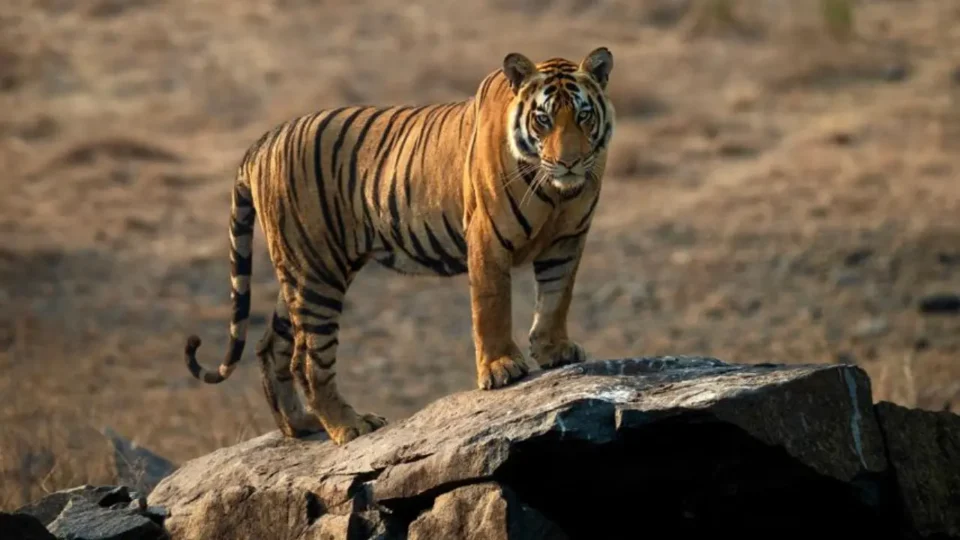
A tiger, a leopard and a cheetah, three of the world`s most-elusive apex predators, were sighted simultaneously in a tourist zone of the Ranthambore Tiger Reserve, a moment experts describe as “extremely rare” and “scientifically intriguing”.
The unusual convergence was witnessed on Sunday in Zone 9 of the reserve, located along the banks of the Chakal river, about 45 minutes from the main gate.
The three apex predators were spotted within an estimated range of one-two kilometres at the same time, thrilling tourists and drawing attention from conservationists, said Ranthambore`s Deputy Conservator of Forest and Deputy Field Director Manas Singh.
“Forest chose to surprise. In Zone 9, a tiger, a leopard, and a cheetah, three of the wild`s most elusive beings, sighted in the same landscape, in a single window of time,” the forest department said on Instagram.
“Moments like these are rare, unscripted, and impossible to plan. They remind us what our forests are truly capable of,” it added.
Singh said the cheetah, named KP-2, is a known wanderer from Madhya Pradesh`s Kuno National Park.
The cheetah entered Rajasthan last week. After the sighting on Sunday, it moved towards Zone 8 of the park, he added.
A specialised joint team from the Ranthambore and Kuno national parks has established a camp at the site. Officials are utilising advanced tracking equipment to monitor the cheetah`s movements around the clock.
Wildlife expert Rajkumar Chauhan said the phenomenon is intriguing because each of the three species occupies a different ecological niche despite being apex predators.
“Such proximity among three large carnivores with distinct territorial and hunting strategies is extremely rare,” he said.
Tigers are dominant, solitary carnivores that control large territories and often suppress the presence of other predators in core areas. Leopards, though adaptable, usually avoid direct encounters with tigers. They tend to shift to denser or more rugged terrain and alter their activity patterns, often becoming more nocturnal.
Cheetahs, in contrast, are diurnal hunters that prefer open grasslands and rely on speed rather than strength, making forested habitats and tiger-dominated landscapes less typical for their movement.
Chauhan said the likelihood of an overlap between these animals at the same time and space is inherently low because they minimise competition through what is known as “niche partitioning”, a process in which competing species use different habitats, resources and active times to reduce competition and coexist, enhancing biodiversity.
He added that such a sighting suggests a temporary convergence driven by ecological factors, such as prey movement, dispersal behaviour and landscape connectivity, rather than sustained coexistence in the same microhabitat.
The Ranthambore Tiger Reserve, spread across about 1,800 square kilometres, currently has around 70 tigers. The vast reserve covers Sawaimadhopur, Dholpur and Karauli districts in Rajasthan, including buffer areas.
It is rich in biodiversity and has an estimated 38 species of mammals, 315 species of birds, 14 species of reptiles and 402 species of plants.
This story has been sourced from a third party syndicated feed, agencies. Mid-day accepts no responsibility or liability for its dependability, trustworthiness, reliability and data of the text. Mid-day management/mid-day.com reserves the sole right to alter, delete or remove (without notice) the content in its absolute discretion for any reason whatsoever.
Ranthambore: Tiger, cheetah, leopard spotted together in `extremely rare moment`