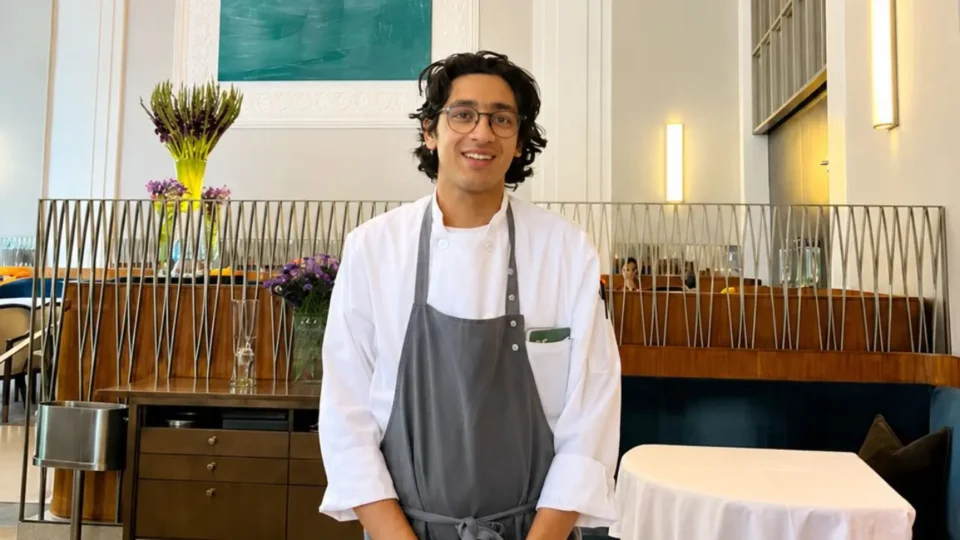
Rahil Mehta speaks in the same way that he performs his craft: measured, precisely, and with a depth that reveals itself gradually. The New York-based pastry chef came to the United States from India to study at the Culinary Institute of America in Hyde Park, New York, and has accomplished one of the great status symbols of a chef; he has held a coveted position as a Chef at Eleven Madison Park, one of the world’s great three-Michelin-star restaurants. In this role, he was critical to the success of the restaurant; he was responsible for all dessert preparation, from daily service to high-profile events. I sat down with him to talk about his journey, his masterful culinary skills, and his move back to Hani’s in the East Village.
What brought you to the United States to pursue cooking?
Food was always the centre of everything at home. But I reached a point where I wanted to understand it scientifically—why techniques work, not just how to execute them. The CIA’s Culinary Science program was unlike anything available to me otherwise. It blended rigorous kitchen training with real food science: fermentation, heat transfer, emulsification. I knew that if I wanted to contribute something meaningful to the culinary world, I needed that foundation.
What was the CIA like, and how did it shape who you are as a chef?
Professor Zearfoss was a significant figure for me. He had worked in Michelin-starred kitchens before joining the faculty, and the way he connected culinary practice to broader science opened something up in me. I became obsessed with pastry—the precision of it, the chemistry. I started collaborating with Chef Daniel Keehner on original dessert recipes outside the curriculum. We developed a deconstructed mille-feuille with strawberry, rhubarb, and vanilla. That project taught me that the most interesting work happens at the edges of what’s expected, rather than sticking with traditions.
You concentrated on dark chocolate ganache at the CIA. Why that subject?
Ganache is one of those preparations that looks simple but is deeply technical. The effect of different sugars on texture, shelf life, and sensory preference—that’s genuinely complex food science. I wanted to master it completely. That work directly informed how I approached the Eleven Madison Park x Central collaboration in February of this year, where I had to improvise a ganache solution under real service pressure. The theory and the practice finally converged and was a huge achievement for me at that early point in my career.
Describe what your role at EMP actually looked like day to day.
Each service, I was responsible for roughly 400 pieces of bread. The timing had to be perfect—every piece needs to proof and bake on an exact schedule so that nothing sits too long before it reaches the guest. I also produced laminated doughs, cakes, confections, and tableside ice cream presentations using liquid nitrogen. The standards at EMP are uncompromising. A three-Michelin-star kitchen doesn’t have margin for inconsistency, and that’s what I loved about it. You are forced to be your best every single night.
What has working at a restaurant like EMP taught you that you couldn’t have learned anywhere else?
That excellence at scale is its own discipline. Anyone can produce one perfect dish. The real challenge is producing hundreds of perfect dishes simultaneously, night after night, under pressure, in front of the most discerning diners in the world. Chef Pascal at EMP has been an incredible mentor in that regard. He came up through some of Europe’s finest kitchens, and he pushes everyone around him to think not just about execution but about emotional resonance—what is this dish making the guest feel?
What’s next for you?
I want to continue mastering my understanding of the science behind what we do in fine dining pastry so I can further strengthen my repertoire of original recipes. For this reason, I am moving onto Hani’s Bakery + Café in the East Village, where I will be soon serving as a Chef and a Kitchen Supervisor. Their philosophy places a deep focus on American baking traditions, and I look forward to contributing to the research and development of their desserts. Longer term, I would love to lead a pastry program where I can help shape the next generation of chefs the way Professor Zearfoss and Chef Rauwolf shaped me. But right now, I’m exactly where I want to be.
"The kitchen became my language": Chef Rahil Mehta shares his culinary journey