
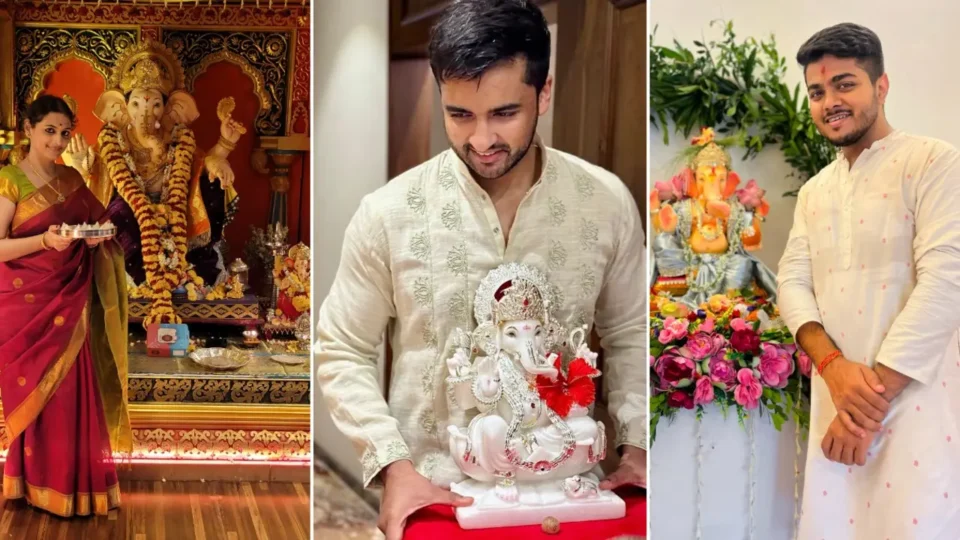
Every year, as the monsoon rains slow down and the streets fill with massive crowds, Ganeshotsav completely transforms the city and country. We have grown accustomed to the grand spectacle of towering fiberglass pandals piercing the skyline, lasers slicing through humid September nights, and the relentless bass of electronic speakers drowning out everything in their path. It is a festival of dazzling scale, a testament to our capacity for collective celebration.
Yet, beneath the glittering neon surface, a quiet ache lingers in the hearts of many. It is the persistent whisper of memory, a longing for an era when the festival was measured not by decibels or crowd size, but by the intimacy of its shared moments. Across India, amid the ongoing celebrations, four distinct cultural voices reflect on the childhood Ganeshotsav traditions they hold most dear, traditions they desperately wish we still practiced today.
The all-night musical baithak
For singer and entrepreneur Jashan Bhumkar, the preservation of ancestral ritual is a daily reality. Growing up in a household where the traditional Maharashtrian vidhi remains untouched by time, Bhumkar feels a profound sense of gratitude. “I feel incredibly fortunate that Ganesh Chaturthi at our home is still celebrated much the way my grandparents and the generations before them celebrated it. The puja follows the traditional Maharashtrian vidhi, and everything from the rituals and aarti to the festive meal served on banana leaves still has that old-world warmth. It is something that has stayed the same in our family, and I think that is why our family and friends look forward to Ganpati every year.”
Despite this adherence to household ritual, the cadence of the festival has shifted outside their walls. For Bhumkar, whose soul was shaped by the rigorous discipline of Hindustani classical music, the most profound loss is the disappearance of the nocturnal musical gathering. “The childhood tradition I miss the most is the all-night musical baithak in Bappa’s presence. Growing up as a Hindustani classical vocalist, Ganpati was never just a religious or social celebration for me. It was also a very special time for music. Classical musicians would gather informally, start singing late at night and continue until the following morning. As a child, I loved being around that music and watching everyone come together just to listen,” he recounts.
These were not the curated, high-pressure performances of modern concert halls. They were organic, unscripted dialogues between artists, time, and devotion. “These were not hurried performances or a series of familiar songs. Artists would sing long, unhurried renditions of raags, along with devotional bhajans, while everyone sat together and listened. There was something very intimate about these gatherings. Nobody was there just to put on a show. Everyone was simply there to be part of the music, be with Bappa and spend time together,” Bhumkar says.
Bhumkar recalls one specific night that etched itself permanently into his memory, a seamless transition from the dead of night into the fragile light of dawn. “One baithak in particular has stayed with me. It started around 11 pm, and went through some rarely heard midnight raags, then gradually moved into the early-morning repertoire. It finally ended around 7 a.m. with Raag Lalit. Seeing how the music changed with each prahar of the night, with Bappa there in the room, was a very meditative experience.”
The erosion of this practice is a symptom of a broader cultural acceleration. As our schedules fill and our attention spans fracture, we have traded the deep, meditative listening of the baithak for fleeting digital entertainment. “I feel these gatherings have reduced as our lives have become busier and we don’t spend as much time sitting and listening to music anymore. I really wish we could bring them back, not just as concerts, but as these intimate gatherings where music, devotion and people could come together. That is what I remember and miss most about Ganesh Chaturthi while growing up, and I would love for future generations to experience something similar,” he hopes.
The joy of immersive kinship
Travel south of Maharashtra to Kolhapur, a city whose earth is deeply saturated in Maharashtrian folklore, and the festival takes on a visceral, kinetic energy. For Bharatanatyam artist Apeksha Niranjan, childhood memories are inextricably linked to her grandmother’s home, where generations collided in a symphony of movement and laughter. “I was born and brought up in Kolhapur, a city in Maharashtra that is deeply rooted in its traditions. During Ganesh Chaturthi, I would go to my grandmother’s house in Kolhapur, and all of us cousins, uncles, aunts and other family members would come together to celebrate.”
In an age where children are often entertained by screens or solitary games, Niranjan’s youth was defined by physical, interactive play that bridged the gap between the youngest toddler and the oldest matriarch. “One tradition I remember very fondly is playing Gauri Ganapati games together on the night of Ganesh Chaturthi. These games would go on for hours, and everyone would participate, from very young children to the older women in the family. We would play games like Fugadi, Zimma, Kombada, Khis Bai Khis and Pinga. We would also sing Gauri Ganapati songs while holding each other’s hands and playing together. There was an element of dance in many of these games, which I particularly enjoyed because I have been dancing since childhood.”
The beauty of these games lay in their collective nature. They required eye contact, physical touch, and verbal wit, elements largely absent from modern socialisation. “What I loved most was that these were not games you played alone. Everyone would hold hands and participate together. Pinga, for instance, was an impromptu question-and-answer game where you had to say something about each other. There was a lot of interaction, laughter and spontaneity,” she fondly remembers.
The games were merely the connective tissue of a larger ecosystem of domestic warmth, culinary craft, and intergenerational storytelling. “Along with these games, we would also have everyone together for the aartis, make traditional food including modaks and spend time talking to each other. The older women would share their experiences and stories with my grandmother and her friends, while everyone else would join in. We never really needed loud music or elaborate dances to enjoy the celebrations. We enjoyed ourselves simply by being together, playing, singing aartis and talking late into the night,” she shares.
For Niranjan, preserving these folk games is not about nostalgic clinging to the past but safeguarding the psychological foundation of community life. “That is what I desperately wish people still practised today. I feel these traditions should continue because they bring everyone together, from children to elders, and allow the younger generation to understand and experience our Maharashtrian traditions. It is a beautiful tradition, and I miss those evenings a lot.”
The radically open door
Sometimes, the tradition we miss the most is not a formal ritual, but an ethical stance woven into the fabric of daily life. For author, climate advocate, and CEO Gautaam Borah, the festival carries a fresh, raw grief following the recent passing of his mother. Yet, that very sorrow brings into sharp focus the single most defining characteristic of his childhood celebrations. “My mother began her onward journey just a month ago, and when it comes to Ganpati celebrations, there is a tradition instilled in the family by my mother. The tradition is not a ritual at all. It is an open door.”
In an era defined by gated communities, digital security systems, and guarded privacy, Borah remembers a home where boundaries dissolved completely during festival seasons. “In my childhood home, my mother turned every festival into a feeding day, and Ganesh Chaturthi was no different. Her door opened to the whole neighbourhood. She prepared poori and chana dal with her own hands, for everyone. No household nearby went without, and no one was left uninvited.”
There was an effortless grace to this hospitality, devoid of the transactional nature of modern hosting. He shares, “There was no queue at our gate, no tokens, no list. People simply came, and food simply reached them. My job was beside her, rolling pooris, then carrying the plates out. I thought I was helping her cook. She was actually teaching me, without ever naming it, what it means to feed people and belong to them.”
This practice was rooted in a profound philosophical understanding of community—one that viewed sustenance not as charity, but as a fundamental expression of shared humanity. “She never called it charity. For her it was community, built one festival at a time, one shared meal at a time. When I asked her why she took so much trouble, her answer was simple. She enjoyed feeding people. The Gita (3.13) says that those who share their food before they eat are blessed, and those who cook only for themselves are not. She lived that verse without quoting it.”
When Borah looks at the modern celebration of Ganesh Chaturthi in financial powerhouses like Mumbai, he sees an inverse relationship between architectural scale and human warmth. “Today, celebrating Ganesh Chaturthi in Mumbai, I see grander pandals and bigger idols than my childhood ever saw. Homes still welcome guests warmly, and prasad is still shared. What has grown rare is the door that needs no invitation.”
The author’s prescription for our hyper-individualised modern lives is deceptively simple and radical in its execution, “Cook a little more than your family needs. Then open the door.”
The sacred sanctuary of the schoolroom
Traditions do not always live within family walls, sometimes, they are forged in the corridors of institutional youth. As an artist and content creator who grew up as a non-Marathi in Odisha, Satya Swagat experienced Ganesh Chaturthi through a completely different cultural lens. “As a non-Marathi, I grew up in Odisha, where Ganesh Chaturthi is celebrated a little differently. We don’t invite Lord Ganesha into every home for days, but our schools, colleges, and pandals celebrate it with so much energy that it’s impossible to forget. If you ask me about my childhood Ganesh Chaturthi memories, they’re all from school. Preparations would begin almost a month in advance with endless meetings, teachers assigning responsibilities to selected students, and all of us excitedly decorating the school a day before the puja. It genuinely felt like the one of the biggest events of the year another one is Saraswati puja which happens in the exact same way.”
For a child, the anticipation of the festival was an education in project management, teamwork, and collective joy. “For us, Ganesh Puja is a one-day festival, but wearing new clothes is a must. And the best tradition? We kept our books near Ganesha for the day because it’s believed he gets angry if you study on Ganesh Puja. Whoever started that tradition honestly deserves an award from every kid,” he jokes.
The culmination of the celebration, the visarjan, offered a rare moment of unbridled social freedom and shared catharsis. “Then comes visarjan, dancing through the streets with friends, loud music, endless excitement, and already waiting for next year.”
Reflecting on the fleeting nature of these institutional memories, Swagat advocates for preserving this specific brand of communal schoolyard magic. “It’s just one day of puja, but an entire month full of memories. I honestly wish this school celebration tradition existed in more places because every child deserves to experience this kind of Ganesh Chaturthi.”
The echoes we choose to carry
Whether it is the haunting strains of Raag Lalit floating through a midnight room as Jashan Bhumkar listens in stillness, the rhythmic clapping of Apeksha Niranjan’s hands during a game of Pinga in Kolhapur, the scent of fresh pooris rolling out of Gautaam Borah’s mother’s open kitchen, or Satya Swagat hiding schoolbooks beneath an altar of flowers in Odisha, these traditions share a common denominator. They are anchors of human connection.
As we navigate the deafening neon sprawl of modern festivals, these reflections remind us of what we risk leaving behind. The grandeur of the pandal matters little if the doors are locked, if the music is automated rather than shared, if the games are played on glass screens, and if the collective joy of the schoolroom is replaced by isolated routine. The true spirit of Bappa does not reside in the height of the plaster idol, but in the quiet spaces where we look one another in the eye, sit together through the dark hours, and open our homes without an invitation.
It makes us wonder, “What is one cherished childhood memory or family tradition from your own festive celebrations that you wish modern life hadn’t pushed aside?”
